
An Operating Architecture for
Adaptive Technical Organizations
The entire Ridgeline architecture at a glance.
Organizational Intelligence
The collective capability to observe reality, connect specialized expertise, build understanding across boundaries, learn from experience, adapt intelligently, and continuously evolve.
Four Interconnected Pillars
Closed-Loop Intelligence • Cross-Functional Fluency • Organizational Adaptability • Continuous Evolution
Two Strategic Application Areas
Design for Adaptation & Evolution • Scale Technical Capability
Six Boundaries of Evaluation
Safety • Quality • Efficiency • Adaptability • Operability • Serviceability
The Ridgeline Framework connects these elements into an operating architecture that enables specialized teams to maintain deep expertise and local autonomy while sharing intelligence, learning across functional boundaries, adapting intelligently, and continuously evolving as one organization.
Operationalizing Organizational Intelligence
Why an operating architecture is necessary.
Organizational Intelligence does not emerge from isolated process improvements, technology deployments, organizational initiatives, or training programs. It requires an operating architecture that connects shared purpose, organizational guardrails, specialized expertise, autonomous execution, real-world observation, reflection, cross-functional learning, and alignment into a continuous system.
The Ridgeline Framework translates the four interconnected pillars of Organizational Intelligence into an operating architecture for connecting how organizations align, execute, observe, learn, communicate, adapt, and evolve.
Align globally
Execute autonomously
Reflect locally
Learn collectively
Adapt Intelligently
Evolve continuously
THE FOUR INTERCONNECTED PILLARS
What Organizational Intelligence requires.
Organizational Intelligence is built upon four interconnected capabilities. Each serves a different function, but none operates effectively in isolation.
Closed-Loop Intelligence:
Connect What the Organization Knows
Observations, data, knowledge, decisions, and experience must return to the people capable of influencing what happens next. Closed loops prevent valuable intelligence from terminating within individual functions and allow experience to become organizational learning.
Cross-Functional Fluency:
Understand Across Specialized Boundaries
Specialized functions must be able to understand one another's language, constraints, dependencies, and operating realities without sacrificing deep domain expertise. Cross-functional fluency allows information to become shared understanding.
Continuous Evolution:
Make Learning and Adaptation Ongoing
Learning must influence what comes next. Products, systems, software, processes, knowledge, tools, and human capability must continue evolving as conditions change. Continuous evolution turns adaptation from an isolated response into an enduring organizational capability.
Organizational Adaptability:
Turn Understanding Into Intelligent Action
Organizations must be capable of translating what they know into timely, informed action as technologies, operating conditions, requirements, and priorities change. Adaptability allows capable people and teams to respond within appropriate organizational guardrails.
Two Strategic Application Areas
Where Ridgeline applies the framework.
The four pillars describe the organizational capabilities Ridgeline seeks to strengthen. In practice, Ridgeline applies those capabilities through two complementary Strategic Application Areas—strengthening both the technical systems organizations depend on and the human capabilities required to operate, service, adapt, and evolve them.
Design for Adaptation & Evolution
Strengthening the Technical System
Designing products, systems, software, diagnostics, workflows, information architectures, and interfaces with explicit consideration for real-world operation, service, changing conditions, and continued evolution.
As vehicles increasingly incorporate connected data, analytics, automation, and AI, intelligent capabilities must function within the larger technical ecosystem. Ridgeline considers the visibility, diagnostics, serviceability, information pathways, human interaction, and feedback required for those capabilities to remain understandable, maintainable, and capable of evolving over time.
Better technical systems reduce unnecessary human burden. Greater technical capability enables people to manage necessary complexity. Organizational Intelligence continuously connects the two.
Scale Technical Capability
Strengthening Human Capability + Enabling Systems
Developing the knowledge, information access, data, tools, interfaces, training, technology, and appropriate autonomy people need to work effectively with increasingly complex technical systems—and evolve alongside them.
As systems become increasingly software-defined and AI-enabled, technical capability includes more than access to information. People must be able to understand system intelligence, evaluate it within real-world context, use it effectively in decision-making, recognize its limitations, and return what they learn to the larger organization.
AI & Intelligent Systems Integration
AI is not a separate Strategic Application Area. It is an enabling capability that can operate across both.
Ridgeline helps organizations evaluate where AI, analytics, connected data, and intelligent decision support can strengthen serviceability and technical capability—while ensuring those technologies remain usable, explainable, maintainable, and connected to real-world field operations.
Within Design for Adaptation & Evolution, this means considering how intelligent capabilities are integrated into the larger technical architecture—including requirements, observability, diagnostics, serviceability, interfaces, changing conditions, and lifecycle evolution.
Within Scale Technical Capability, it means ensuring people have the knowledge, context, information, tools, and decision support required to interact effectively with increasingly intelligent systems.
Ridgeline focuses on the architecture surrounding these technologies: requirements, serviceability, technical workflows, human interaction, organizational interfaces, field integration, and feedback. Specialized model development, data engineering, and software implementation may be performed in collaboration with appropriate engineering and technology specialists when required.
Organizational Adaptability
Continuous Evolution
Strengthening Organizational Intelligence
How both Application Areas strengthen all Four Pillars.
Both Strategic Application Areas operate across all four pillars. One strengthens the design and behavior of the technical system; the other strengthens the human capability and enabling infrastructure required to understand, operate, service, and continuously improve it.
Closed-Loop Intelligence
Cross-Functional Fluency
Design for Adaptation & Evolution
Designs technical systems with the visibility, feedback, and information pathways required to observe real-world behavior, identify emerging issues, and return operational and service insight to the people responsible for system improvement.
Brings engineering, operations, and service perspectives into system design so technical decisions reflect not only intended function, but also how systems will be operated, understood, diagnosed, maintained, and improved in the field.
Creates technical systems that can accommodate changing requirements, technologies, operating conditions, and field needs without unnecessary disruption or dependence on workarounds.
Establishes the technical foundation for systems to improve over time as field experience, new technology, changing requirements, and organizational learning inform future design decisions.
Scale Technical Capability
Develops the mechanisms for field experience, technical knowledge, diagnostic insight, and workforce feedback to be captured, shared, and returned to the organization rather than remaining isolated with individuals or functions.
Builds the shared understanding required for engineers, operators, technicians, technical leaders, and other specialists to communicate effectively across functional boundaries and solve increasingly complex problems together.
Strengthens the ability of people and supporting knowledge systems to respond effectively as products, technologies, tools, processes, and technical requirements change.
Creates the learning infrastructure and technical capability required for workforce knowledge, skills, practices, and decision-making to advance alongside increasingly complex systems.
Build good systems.
Develop capable people.
Connect them through Organizational Intelligence.
Six Boundaries of Evaluation
How decisions and changes are evaluated.
Across both Strategic Application Areas, Ridgeline evaluates technical and organizational decisions through six interconnected boundaries. These boundaries help expose downstream consequences, competing priorities, and situations where improvement in one area may unintentionally transfer risk or complexity elsewhere.
Safety
Quality
Efficiency
Adaptability
Operability
Serviceability
Protect people first.
Build confidence through reliable performance.
Eliminate unnecessary effort.
Remain capable as conditions change.
Design for effective real-world use.
Design for diagnostics, maintenance, and recovery.
Optimization within one boundary should not create unacceptable consequences within another. The objective is balanced system performance across the complete lifecycle.
Preserving Local Expertise, Sharing Enterprise Intelligence
Where the architecture operates organizationally.
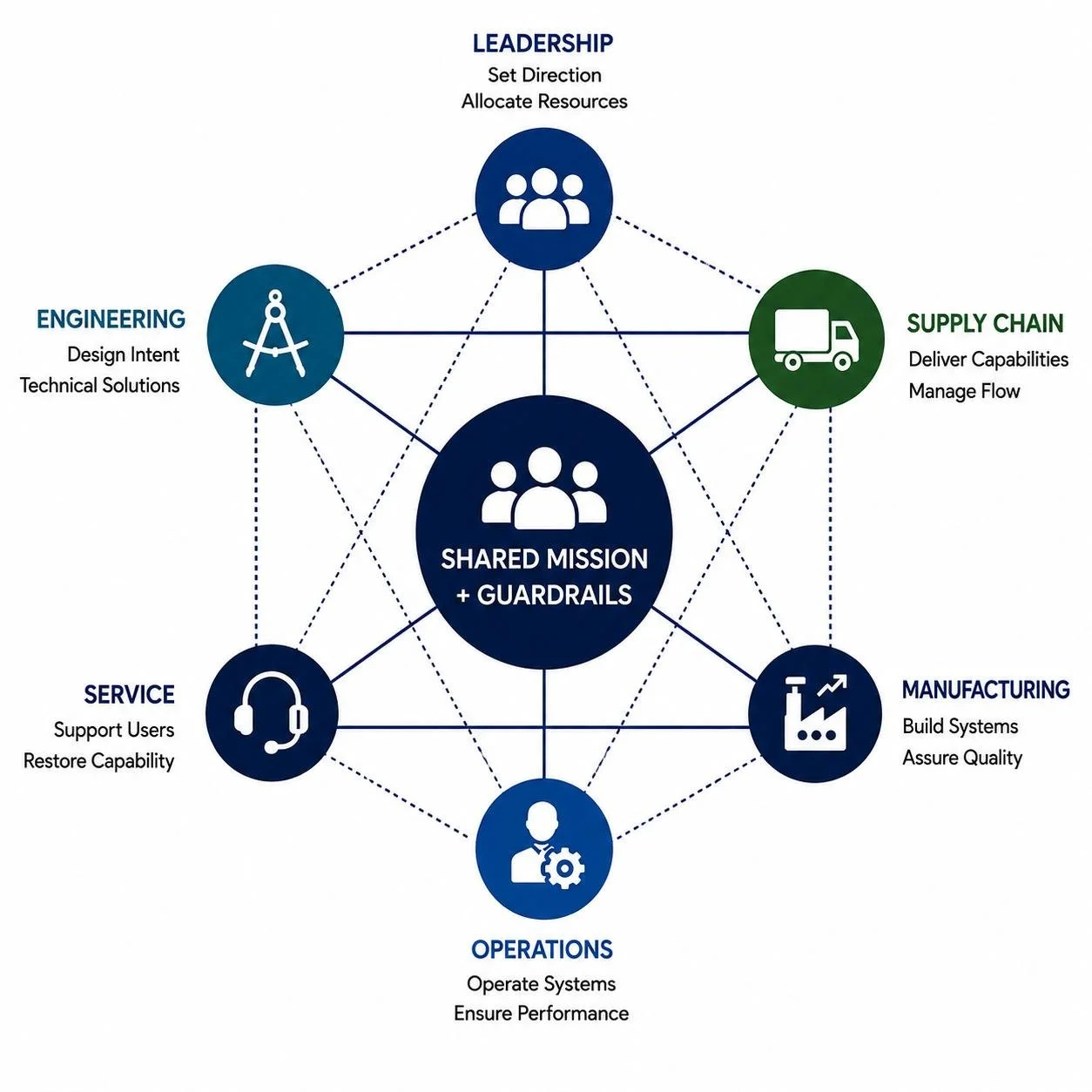
Specialized functions must remain specialized. Their expertise, responsibilities, perspectives, and operating environments are fundamentally different. What must change is the architecture connecting them.
Rather than allowing relevant information to terminate within rigid organizational boundaries, the Ridgeline Framework establishes pathways through which observations, data, knowledge, constraints, decisions, and operational experience can move across the enterprise.
Individual functions retain autonomy within established guardrails while the broader organization gains access to the intelligence those functions create.
The objective is not to eliminate specialization. It is to connect specialized expertise so the organization can learn and act as a system.
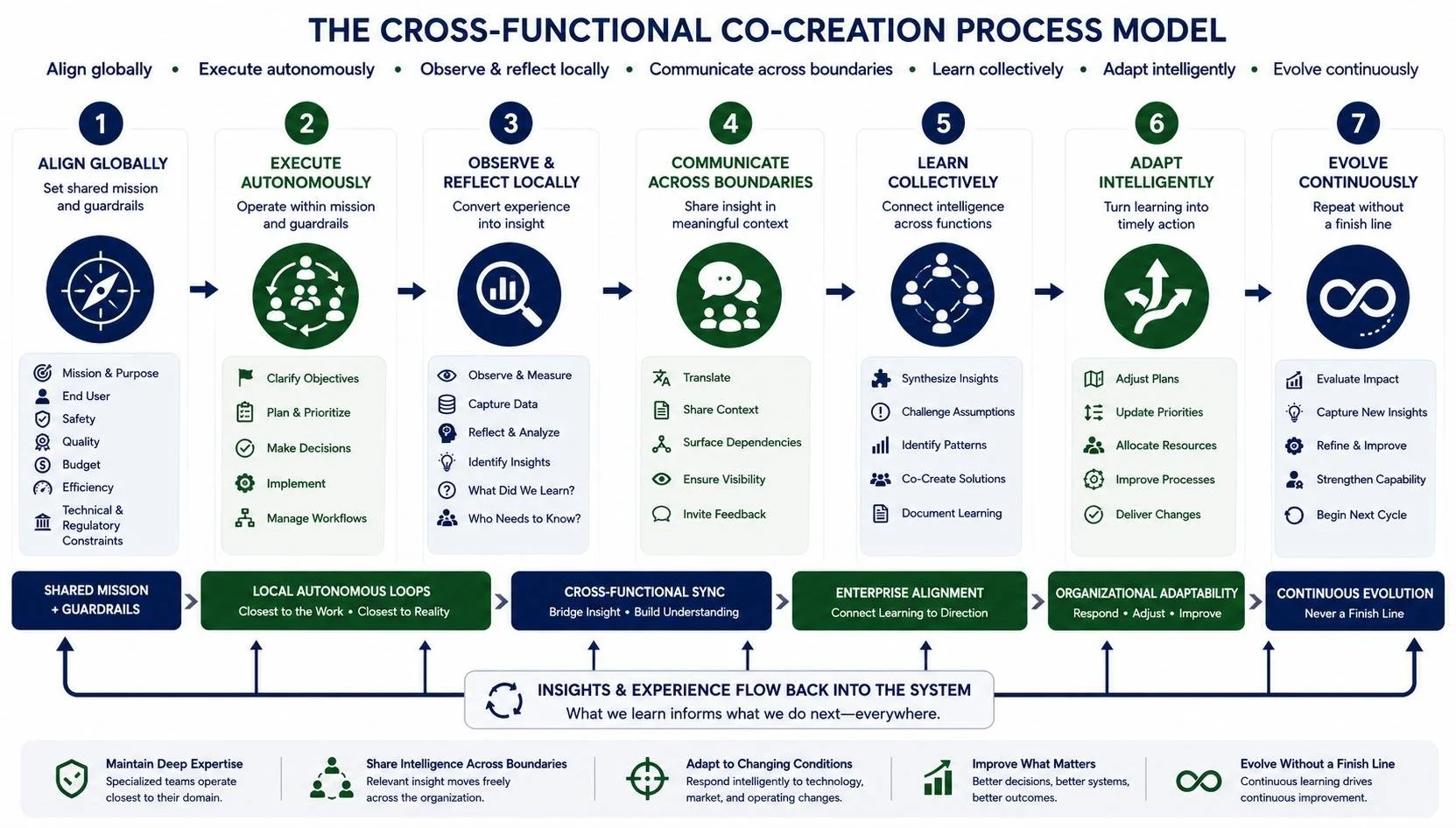
The Cross-Functional Co-Creation Process Model
The visual operating model.
The Architecture in Execution
How the operating model actually works.
The Ridgeline Framework becomes operational when alignment, autonomous execution, observation, communication, collective learning, adaptation, and evolution function as a connected system. Each serves a distinct purpose, while intelligence and experience continuously flow back through the organization to inform what happens next.
01 — Shared Mission + Guardrails
Align Globally
Autonomy requires alignment. Shared mission, priorities, and guardrails establish the boundaries within which specialized teams can make decisions without unnecessary centralized control.
Depending on the environment, organizational guardrails may include end-user requirements, safety, quality, budget, efficiency, and technical or regulatory constraints.
The objective is not to prescribe every action. It is to establish enough shared direction that distributed decisions remain aligned with the broader mission.
02 — Local Autonomous Loops
Execute Autonomously:
Specialized functions operate closest to different parts of reality. Engineering understands design intent. Operations understands real-world execution. Service understands field behavior, diagnosis, repair, and recovery.
Within shared guardrails, capable teams must be able to plan, decide, implement, observe, and adjust within their areas of expertise without requiring the entire enterprise to participate in every decision.
Autonomy allows expertise to operate at the speed and proximity required by the environment. Guardrails prevent autonomy from becoming fragmentation.
03 — Reflection
Convert Experience Into Insight:
Convert Experience Into Insight
Execution alone does not create learning. Teams must deliberately observe what happens after decisions and changes are implemented and compare outcomes with expectations.
What happened? What did we observe? What does the data show? What did we expect? What was different? What have we learned? Who else needs to know?
Observation captures reality. Reflection gives it meaning.
Together, they convert local experience into structured insight that can influence what happens next.
Without observation and reflection, organizations accumulate experience without necessarily accumulating understanding.
04 — Cross-Functional Sync
Communicate Across Boundaries
Insight creates little organizational value when it remains within the function where it originated.
Cross-functional sync creates structured opportunities for specialized teams to translate what they know, share relevant context, surface dependencies, challenge assumptions, and make intelligence visible to the people who need it.
This is where Cross-Functional Fluency becomes operational.
The objective is not more communication. It is more meaningful communication—allowing specialized expertise to remain deep while relevant intelligence moves across organizational boundaries.
05 — Enterprise Alignment
Learn Collectively:
Individual observations may reveal local conditions. When intelligence from multiple functions is connected, the organization can identify patterns, dependencies, risks, opportunities, and systemic conditions that may not be visible from any one perspective.
Collective learning allows those insights to influence priorities, resources, decisions, standards, and organizational direction.
Alignment does not mean centralizing every decision. It means ensuring that what the organization learns can influence what the organization does.
This is an important refinement from the original. Enterprise Alignment isn't merely management reviewing information. It is where distributed intelligence becomes organizational learning and direction.
06 — Organizational Adaptability
Turn Learning Into Intelligent Response:
Learning creates value when it changes what happens next.
Teams respond. Plans adjust. Resources shift. Priorities change. Products improve. Processes are redesigned. Knowledge evolves. Capabilities develop.
Organizational Adaptability emerges when the organization can translate what it has learned into timely, informed action without requiring a major transformation initiative every time conditions change.
Adaptability is not simply another step in the process. It is a capability produced when the system operates effectively.
07 — Continuous Evolution
Repeat Without a Finish Line:
There is no final optimized state.
Implementation creates new conditions. New conditions produce new observations. Observations create new learning. Learning informs adaptation. Adaptation creates another opportunity to improve the system.
Products evolve. Software evolves. Processes evolve. Knowledge evolves. Human capability evolves. The organization itself evolves.
The output of one cycle becomes input to the next.
Continuous Evolution is not the end of the framework. It is the reason the loop continues.

From Architecture to Strategic Engagement
The Ridgeline philosophy defines what adaptive technical organizations must be capable of. The Ridgeline Framework connects those capabilities into an operating architecture. Strategic Engagements apply that architecture to real-world challenges through two complementary areas—Design for Adaptation & Evolution and Scale Technical Capability.
Whether the challenge originates in Engineering, Operations, Service, or the boundaries between them, the objective is the same: understand the larger system, connect the relevant expertise and intelligence, strengthen internal capability, and create the conditions for continued adaptation and evolution.
Emerging capabilities such as AI, analytics, connected data, automation, and intelligent decision support are considered within this larger architecture—not as isolated technology deployments, but as components that must work effectively with the technical systems, people, information, and organizational processes surrounding them.