
Strategic Engagements
Applying the Ridgeline Framework at the Intersection of Engineering, Operations & Service
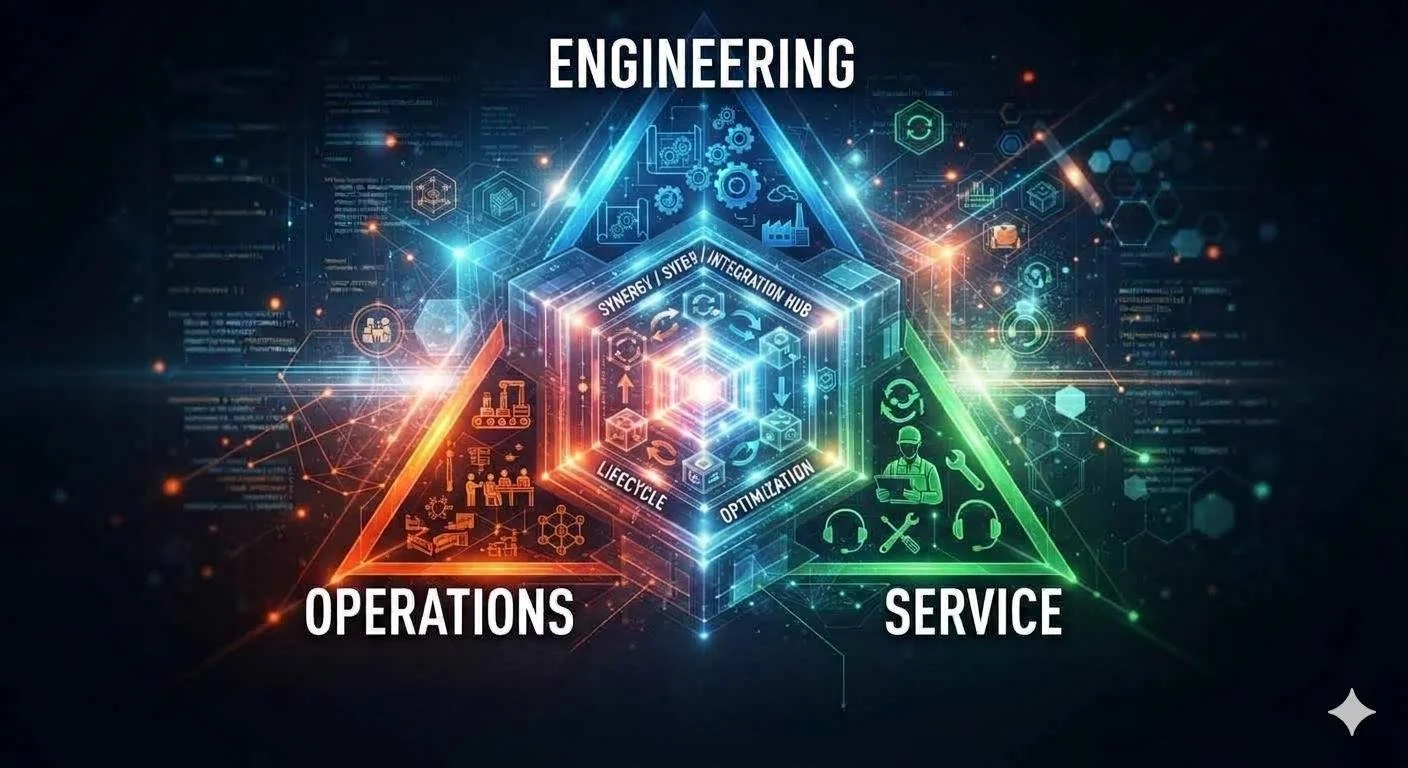
Ridgeline works where engineering decisions, operational realities, and service experience intersect—connecting specialized expertise, translating across functional boundaries, and creating the pathways through which technical intelligence can move, inform decisions, strengthen capability, and drive continuous learning, adaptation, and evolution.
Where Ridgeline Engages
Engineering ↔ Operations ↔ Service
Complex technical challenges rarely remain within the boundaries where they originate.
An engineering decision can create operational consequences.
An operational constraint can expose a product limitation.
A difficult diagnosis can reveal a design, software, information, tooling, or capability problem.
And field experience can expose opportunities that may never become visible through engineering data alone.
Ridgeline engages across these intersections—where understanding one function is not enough to understand the entire problem.
The objective is not to force a problem into a predefined service offering. It is to understand the system producing it.
Two Strategic Application Areas
Ridgeline applies the four interconnected pillars of Organizational Intelligence through two complementary Strategic Application Areas—strengthening both the technical system and the human capability and enabling infrastructure required to work effectively with it.
01 — Design for Adaptation & Evolution
Strengthen the Technical System
Technical systems should not simply perform well at introduction. They must remain capable as technologies, software, operating conditions, requirements, and real-world experience continue to change—and be designed so learning from those conditions can influence what comes next.
As vehicles increasingly incorporate connected data, analytics, automation, and AI, these capabilities must also remain observable, understandable, diagnosable, maintainable, and serviceable within the larger technical ecosystem.
Engagements may examine questions such as:
Can the product be safely and effectively operated under real-world conditions?
Can failures and degradation be efficiently observed, diagnosed, accessed, and resolved?
Are manufacturing or engineering efficiencies transferring unnecessary complexity downstream?
Can the architecture accommodate future changes without disproportionate redesign?
Are field observations informing subsequent technical decisions?
Are intelligent capabilities creating actionable technical information—or simply adding another layer of complexity?
Better downstream outcomes often begin with better upstream decisions.
02 — Scale Technical Capability
Strengthen the People and Systems Surrounding the Product
Increasing technical complexity cannot be addressed indefinitely by adding specialists, procedures, training requirements, or support layers.
The environment surrounding the technical workforce must also evolve.
As systems become increasingly software-defined, connected, and AI-enabled, people need more than access to technology. They need the information, context, tools, knowledge, and decision support required to understand what the system is communicating, recognize limitations, exercise informed judgment, and act effectively.
Ridgeline examines the interconnected conditions that enable people to perform effectively and evolve alongside increasingly complex technical systems:
Then retain your six categories, with a couple of refinements:
Education & Training
Systems understanding • foundational principles • diagnostic reasoning • applied learning • cross-functional awareness
Human + System Interface
Usability • nomenclature • logical workflows • data visibility • system status • interaction & control
Information & Knowledge Access
Technical information • specifications • contextual knowledge • historical information • decision support
Data Access
Telemetry • faults • event history • configuration • software state • relevant operational context
Tools & Technology
Diagnostic tooling • analytics • AI-enabled decision support • automation • visualization • simulation • AR/VR
Autonomy Within Guardrails
Information • context • trust • decision authority • clearly established boundaries
Scaling technical capability means designing the conditions that allow capable people to perform effectively as necessary complexity increases.
SIX BOUNDARIES OF EVALUATION
Across both Strategic Application Areas, Ridgeline evaluates decisions, designs, and changes through six interconnected boundaries:
Safety • Quality • Efficiency • Adaptability • Operability • Serviceability
The objective is not to optimize one dimension in isolation, but to understand how decisions and changes affect the larger technical system across its lifecycle.
When to Engage Ridgeline
The Symptoms Often Appear Before the Systemic Problem Is Visible
Organizations may experience:
Products becoming increasingly difficult to operate, diagnose, maintain, or support.
Engineering lacking meaningful visibility into operational and field experience.
Service repeatedly encountering problems whose underlying causes remain unresolved upstream.
Technical knowledge becoming concentrated among a small number of experts.
Software and other technologies evolving faster than downstream diagnostic, information, tooling, or workforce capability.
Interfaces, terminology, diagnostics, documentation, or tooling creating unnecessary cognitive burden.
Operational scaling exposing weaknesses that worked adequately at smaller volumes.
AI, analytics, automation, or intelligent decision-support technologies being introduced without sufficient consideration of workflow, data and information quality, human judgment, serviceability, technical context, field integration, or downstream consequences.
Valuable vehicle, diagnostic, and operational data existing without becoming actionable technical intelligence.
The same problems recurring because lessons learned in one function fail to influence another.
These problems rarely exist in isolation. Ridgeline traces them across the technical system to identify the relationships and conditions producing them.
How We Engage
01 — Observe & Map
Understand before acting.
Examine the real operating environment, technical system, workflows, information pathways, constraints, dependencies, and people involved before recommending change.
02 — Analyze & Connect
Identify the system behind the symptom.
Connect observations across Engineering, Operations, and Service to identify constraints, disconnects, unnecessary complexity, capability gaps, information barriers, dependencies, and recurring patterns.
03 — Co-Create & Design
Develop practical solutions with the people closest to the work.
Translate findings into practical recommendations, requirements, architectures, workflows, capability improvements, or implementation roadmaps with the people responsible for designing, operating, diagnosing, maintaining, and supporting the system.
04 — Support Implementation, Observe & Learn
Learn from what happens next.
Where implementation is within the engagement scope, support the organization and appropriate technical specialists as changes are introduced. Observe real-world outcomes, compare them with intended outcomes, reflect on what occurred, communicate what was learned, and refine recommendations as new intelligence emerges.
05 — Transfer Capability & Enable Evolution
Build the capability to continue without Ridgeline.
Transfer the knowledge, practices, tools, relationships, ownership, and learning mechanisms necessary for the organization to continue observing, learning, communicating, adapting, and evolving independently.
Engagements are iterative and scalable rather than strictly sequential. Depending on scope, an engagement may focus on assessment, findings, recommendations, solution design, implementation support, learning, or a combination of these as new intelligence emerges.
Engagements Are Shaped Around the Problem
The scope of an engagement depends on what the initial investigation reveals. Depending on the challenge, work may involve several interconnected areas.
Cross-Functional & Information Flow Mapping
Functional relationships • communication pathways • translation gaps • decision pathways • feedback loops • knowledge flow
Technical Design & Lifecycle Review
Safety • quality • efficiency • adaptability • operability • serviceability • diagnostics • accessibility
Human + System Interface Assessment
UI/UX • nomenclature • workflows • data visibility • system status • interaction & control • cognitive burden
Diagnostic & Technical Capability Assessment
Diagnostic strategy • education • technical knowledge • data access • tooling • escalation • decision autonomy
Closed-Loop Intelligence Architecture
Observation • information flow • reflection • cross-functional sync • shared learning • organizational feedback
AI & Intelligent Systems Integration
Use-case evaluation • requirements • serviceability • workflow integration • information and data context • human + system interaction • decision support • field feedback • lifecycle considerations
Ridgeline helps organizations determine where AI, analytics, connected data, automation, and intelligent decision support can strengthen serviceability and technical capability—and what is required for those technologies to function effectively within the larger technical and organizational system.
Ridgeline's focus is the architecture surrounding intelligent systems rather than specialized model or software development. Where an engagement requires model development, data engineering, or software implementation, Ridgeline can work alongside appropriate engineering and technology specialists.
The engagement follows the problem—not a predetermined consulting package.
Engagement Scale
Targeted Assessment
A focused investigation into a defined technical, operational, service, or cross-functional challenge.
Cross-Functional Engagement
A challenge spanning Engineering, Operations, Service, or the interfaces between them.
Systems Architecture Initiative
Design or redesign of a broader technical capability, diagnostic environment, support system, information architecture, intelligent-system integration, or organizational learning framework.
Ongoing Strategic Advisory
Periodic systems-level guidance as products, technologies, capabilities, and operating requirements continue to evolve.
What Ridgeline Leaves Behind
Capability That Remains With the Organization
A successful engagement should leave the organization more capable than when Ridgeline arrived.
Greater cross-functional fluency.
Clearer intelligence pathways.
Better understanding of system relationships.
Stronger technical capability.
Better interfaces and diagnostics.
More effective integration of data, analytics, and intelligent technologies into real-world technical work.
Greater autonomy within appropriate guardrails.
Stronger learning loops.
Internal ownership of the resulting improvements.
Greater capacity to adapt and evolve as conditions change.
Ridgeline does not seek to become another permanent organizational layer. We design frameworks, develop capability, connect expertise, and transfer knowledge so technical organizations become increasingly capable of learning, adapting, and evolving independently.
The Objective
The Capability to Adapt & Evolve
Strategic engagements are not built around the assumption that today's solution will remain optimal indefinitely.
They strengthen the organization's ability to observe what changes, understand what it means, communicate what is learned, connect the people and expertise required to respond, adapt intelligently, and continuously improve what comes next.
The goal is not a static solution. It is the internal capability to continuously learn, adapt, and evolve.
Begin a Strategic Conversation
Where is rapid, continuous change exposing limitations between Engineering, Operations, and Service?
Every organization encounters these challenges differently.
The first step is understanding where the friction exists, what is creating it, and what other parts of the technical system it affects.